Pedagogical experience
learning from error in the development of engineering competencies
DOI:
https://doi.org/10.64876/radi.v28.3Keywords:
error analysis, flipped classroom, algebra, engineering competencies, metacognitive reflectionAbstract
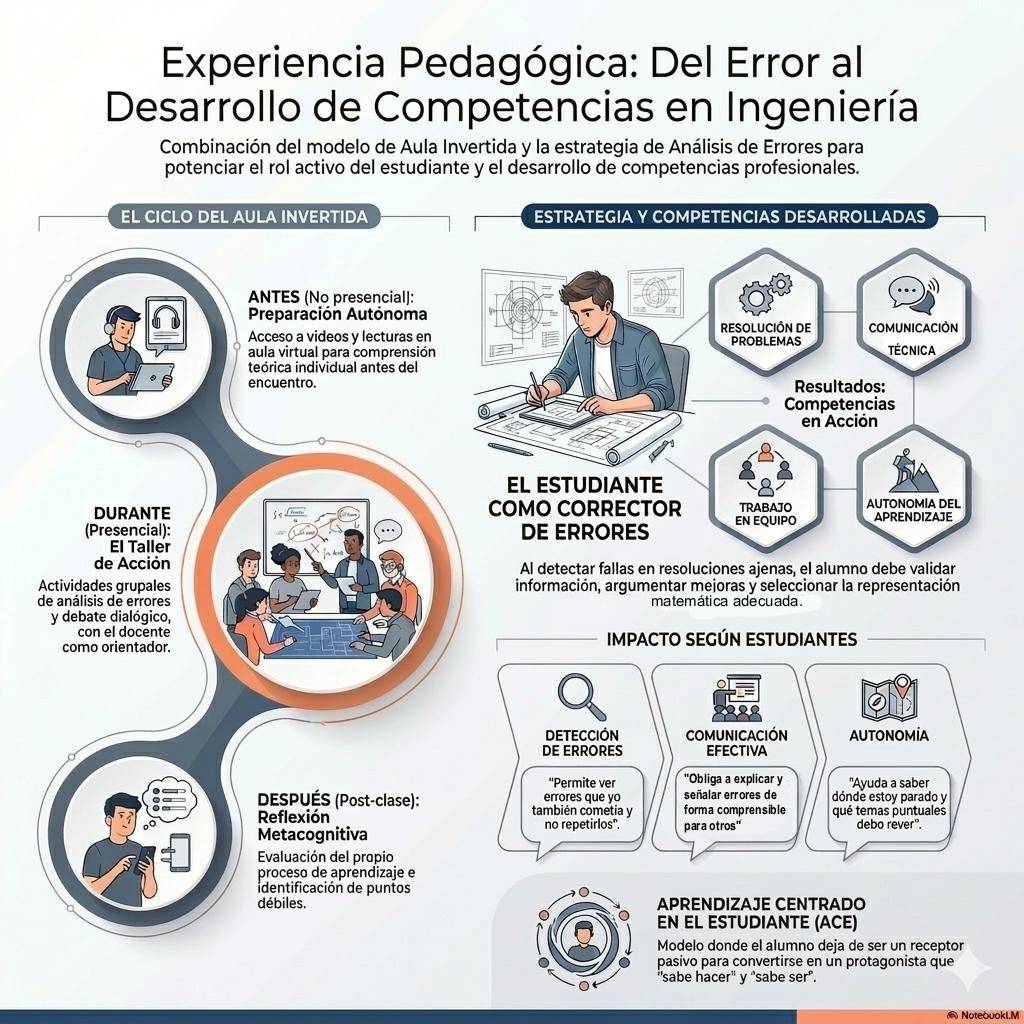
This work describes a pedagogical experience implemented in a first-year Algebra course for engineering careers at the National University of Mar del Plata (Argentina). Within the framework of the flipped classroom methodology, an error analysis activity on complex numbers was designed and carried out, in which students were required to detect, justify, and guide the correction of erroneous solutions produced by anonymous students from previous cohorts. The objective was to promote an active student role and support the initial development of generic engineering competencies. After the activity, students responded to a metacognitive prompt regarding their own learning. Qualitative analysis of the responses reveals a positive assessment of the experience by the students; most acknowledged that the task allowed them to deepen their understanding of concepts, identify their own mistakes, and improve self-regulation. It is concluded that, although it poses a challenge for instructors, it is feasible to integrate competency development into basic sciences through active methodologies.
Downloads
References
Consejo Federal de Decanos de Ingeniería (CONFEDI). (2014). Cuadernillo de Competencias. [PDF] https://confedi.org.ar/wp-content/uploads/2020/04/Cuadernillo-de-Competencias-del CONFEDI.pdf
Consejo Federal de Decanos de Ingeniería (CONFEDI) (2018). Propuesta de estándares de segunda generación para la acreditación de carreras de Ingeniería en la República Argentina Libro rojo de CONFEDI. Universidad Fasta Ediciones. https://confedi.org.ar/download/documentos_confedi/LIBRO-ROJO-DE-CONFEDI-Estandares-de-Segunda-Generacion-para-Ingenieria-2018-VFPublicada.pdf
Felder, R. (2022). Educación STEM: Historia de dos paradigmas. Revista Argentina de Ingeniería, 20, 10-20. https://www.radi.org.ar/index.php/radi/article/view/108
Fernández-Martín, F.D., Romero Rodriguez, J.M., Gómez García, G. y Navas Parejo, M.R. (2020). Impact of the Flipped Classroom Method in the Mathematical Area: A Systematic Review. Mathematics, 8, 12, diciembre de 2020, p. 2162. https://doi.org/10.3390/math8122162
Kowalski, V., Morano, D., Erck, I., Enríquez, D. y Cirimelo, S. Programa de Formación Docente para orientar su práctica hacia la Formación por Competencias. Módulo 2: Mediación Pedagógica para la Formación de Competencias. Segundo Documento ¿A Quién Enseño Yo, Entonces? (2019).
Molina, K. P. R., & Llaguno, L. S. V. (2025). Creación y análisis de errores como estrategia para el aprendizaje matemático. Revista Científica de Innovación Educativa y Sociedad Actual" ALCON", 5(4), 695-702. https://doi.org/10.62305/alcon.v5i4.799
Observatorio del Instituto para el Futuro de la Educación. (2014). Aprendizaje invertido (EduTrends). Tecnológico de Monterrey. https://observatorio.tec.mx/edutrends-aprendizaje-invertido
Prieto, A., Barbarroja, J., Álvarez, S. y Almuzara, A. (2021). Eficacia del modelo de aula invertida en la enseñanza universitaria: una síntesis de las mejores evidencias. Revista de Educación, 391,149-177. https://doi.org/10.4438/1988-592x-re-2021-391-476
Reyes, K., Trujillo, B. P. S., Litardo, A. C. C. y de los Ríos, T. C. (2025). El aula invertida en el aprendizaje de matemática en estudiantes universitarios: una revisión sistemática. Revista científica en ciencias sociales, 7, 01-17.
Rodríguez, M. A. (2025). Perspectivas metodológicas en la enseñanza y en la investigación en educación matemática (4ta. edición, revisada y ampliada). http://repositorio.ungs.edu.ar:8080/xmlui/handle/UNGS/2535
Ryals, M., Hill-Lindsay, S., Pilgrim, M. E., y Burks, L. C. (2025). 'Simple Mistakes' in College Algebra: an Analysis of Students' Perceptions of Their Errors Using Attribution Theory. International Journal of Research in Undergraduate Mathematics Education, 1-28. DOI:10.1007/s40753-025-00269-3
Downloads
Published
How to Cite
Issue
Section
License

This work is licensed under a Creative Commons Attribution-NonCommercial-ShareAlike 4.0 International License.